A market entry strategy is a process for validating demand, identifying target customers, evaluating profitability, and developing a plan to successfully launch a product or service into a new market.
These six pillars establish the framework to develop an effective strategy:
- Validate Demand
- Define Target Customer
- Develop Positioning
- Validate Profitability
- Create a Go-To-Market Plan
- Build a Distribution Strategy
A market entry strategy helps answer:
- Who are we targeting in this new market?
- What value are we offering compared to existing alternatives?
- How will we reach and acquire our first customers?
- Will this new offering be profitable? (and can you scale it)
These tools identify unmet customer needs, uncover market trends, and help develop your strategy:
- Product features: MaxDiff & Conjoint Analysis to see which product people value, based on statistical models.
- Product pricing: Gabor Granger to find the revenue-maximizing price point. Van Westendorp to find a range of acceptable prices (ideal for new products)
- Demand metrics: Use Google Trends or Ahrefs to see if people are actively searching for your solution online and if that demand is growing.
- Retail sales: Use location intelligence software. These tools combine regional demographics, uncover nearby competitors, and analyze traffic data to generate sales forecasts for proposed real estate investments.
- Competitor gaps: Analyze your competitors’ 2 and 3-star reviews on sites like Google or G2 (use an API and an LLM to quickly group and tag the text) to expose product flaws.
- Operational feasibility: Use labor modeling tools to convert early demand projections into staffing rules and shift calculations. This ensures that a business that appears profitable in quick calculations doesn’t collapse under real-world wages, payroll taxes, and compliance constraints.
1. Validate Demand
Before entering a new market, the first question is not if the idea is good, but if there is demand for it. Validating demand is a critical first step that requires you to confirm three things:
- The problem actually exists
- People care enough about it to change their behavior
- There is willingness to pay or engage consistently
If one of these is missing, the market opportunity is weak or incomplete.
Survey Research
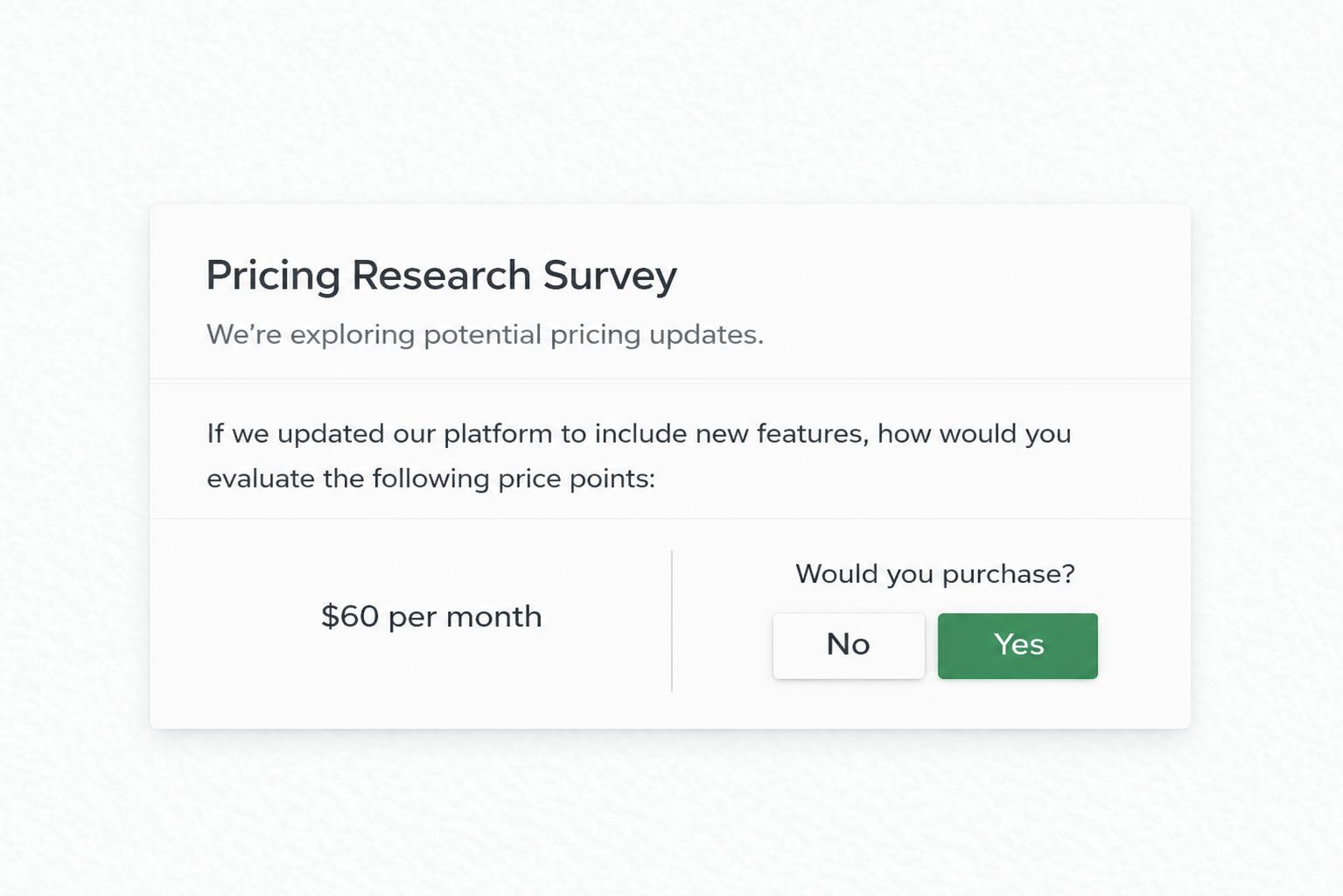
Surveys allow you to reach a sample of potential customers to measure interest, the problems they’re trying to solve, and what they would pay. They are fast and scale well, which makes them a natural starting point for sizing demand.
Customer Interviews
Customer interviews build on survey findings by providing qualitative insights. Through 5–15 in-depth conversations, you can understand why people behave the way they do, how they currently solve the problem, what frustrations they face, and the language they use to describe their needs.
Competitor Analysis
The presence of competitors is often a positive signal: it shows that customers already recognize the problem and are willing to pay for solutions. Looking at competing offerings can also reveal opportunities for you. By analyzing feature sets, pricing models, customer reviews, and common complaints, you can identify unmet needs and areas where current solutions fall short.
These gaps can help you differentiate your product through better functionality, a simpler user experience, lower pricing, or by serving a specific niche that competitors have overlooked.
Competitor pricing research can help you estimate what customers expect to pay, how saturated the market is, and what level of value is required to compete.
Search Traffic Data
Tools such as Google Search, Google Trends, and keyword research platforms can show how often people search for a particular problem, solution, or product category. High search volume and consistent trends suggest that interest already exists, while rising search patterns may indicate an emerging opportunity.
Google Trends is especially useful for understanding whether demand is growing, seasonal, or declining. Comparing related terms can also help identify which customer needs or product categories are gaining traction over time.
Marketplaces and Forums
Reddit threads, Amazon reviews, and support complaints are unfiltered. People describe what frustrates them about current options in language that no survey question would draw out. Across all of these, you should look for three signals: a clear, recurring pain point, gaps in the options people currently use, and a genuine willingness to pay.
2. Define Target Customer
At the market entry stage, starting with a narrow customer segment is important because it reduces ambiguity and simplifies decision-making. A focused segment helps you develop stronger messaging, choose the right acquisition channels, and prioritize features. While you can expand into adjacent segments later, narrowing a broad product after launch is much more difficult.
Demographics
Start by clearly identifying who the customer is in concrete terms. For consumer products, this can include factors such as age, income, location, occupation, and lifestyle; company size, industry, and geographic market; and the specific roles or departments involved in purchasing decisions. The goal is to move from a vague “everyone who has this problem” to a precise description of the group most likely to buy first.
Use Case
Many products can address multiple needs, but successful businesses typically start by solving one problem exceptionally well. Identify the primary use case and the specific pain point your target customers are trying to address. This clarity helps you build a product that feels purpose-built rather than generic, and it ensures that your early validation is tied to a specific, measurable need.
Early Adopters vs. the Broad Market
Early adopters are the most important starting point. These are the users who feel the problem most intensely and are actively seeking a solution. They are more open to experimentation, more forgiving of missing features, and more likely to give real, actionable feedback.
The broader market, on the other hand, typically requires stronger proof, clearer positioning, and a more polished product. Winning over early adopters can help you both validate demand and generate testimonials and referrals that support expansion into the broader market later.
3. Positioning: Why Choose You
Positioning answers a single question in the customer’s mind: why you, and not the alternative? Clear positioning is built from a few decisions:
- Price vs. competitor price: Are you cheaper, premium, or priced similarly but delivering different value?
- Features or niche focus: Being the best option for a specific use case almost always beats being a average option for everyone. You can use MaxDiff analysis to identify which product features customers value most. It is an excellent way to quantitatively measure and close the gaps between you and your competitors.
- Value proposition: State, in one plain sentence, the specific value you offer and to whom. If it could describe a competitor equally well, it’s not good positioning yet.
The way you understand your strengths and the way customers understand them are often different, so it makes sense to test your positioning. Use surveys and interviews to put different value propositions in front of your target segment and see which one they respond to best.
This matters because positioning shapes everything that happens next. It sets your message, narrows your channel choices, and informs your price. If you get this step right, the subsequent execution steps will be far more straightforward.
4. Profitability
A business can grow quickly and still be failing. If it loses money on every customer, growth only speeds up the loss. Before you raise capital and commit to the strategy, the single most important thing to confirm is that the model makes money on paper first, then in practice.
Pricing vs. Costs
Start with unit economics: what does it cost to deliver one unit of your product or one instance of your service, and what do you charge for it? The gap between those two numbers is your margin, and it funds marketing, salaries, and further growth.
If the price doesn’t comfortably exceed the cost of delivery, no amount of volume can fix the problem and will, in fact, make it worse.
Customer Acquisition Cost vs. Revenue
Acquiring a customer costs money: marketing spend, sales time, and partnership fees. That figure is your customer acquisition cost (CAC). Set it against the revenue a customer brings over their lifetime with you (their lifetime value).
Does lifetime value meaningfully exceed acquisition cost?
- A common benchmark is that a customer should be worth several times what it costs to acquire them, leaving room for everything other than acquisition.
- If relying on organic growth (content and SEO) be sure to include related expenditures as acquisition costs.
How long does it take for a customer to pay back their acquisition cost?
- A shorter payback period means less capital tied up while you wait, which matters a great deal in the early days.
Financial Modeling
When validating profitability, you must map out the economic viability of your expansion. Effective financial modeling translates your business strategy into numbers over time, projecting revenue, costs, and cash flow under specific assumptions. The true value of this process lies less in producing flawless forecasts and more in revealing the exact market conditions your business must achieve to succeed.
Build the model around the variables that matter most: pricing, customer acquisition costs, conversion rates, gross margins, and the time it takes customers to generate revenue. Identify the assumptions with the greatest impact on profitability and cash requirements, then test how the business performs under less favorable conditions. For example, model scenarios in which acquisition costs double, sales cycles lengthen, or revenue grows at only half the expected rate.
This exercise helps to determine how much capital the business requires, if and when additional funding may be needed, and which metrics must be closely monitored. A model that delivers acceptable results only under optimistic assumptions is a warning sign.
Labor Modeling
For operations-intensive businesses (retail, manufacturing, logistics, or services), labor is often the largest expense and one of the easiest to underestimate. Because these costs scale with growth, you should be conducting labor modeling to calculate detailed financial metrics.
Start by defining:
- Staffing needs: How many people are required to operate, and at what skill level?
- Hours per location or unit: How many labor hours does each store, shift, or unit of output actually consume?
- Impact on margins: Once those hours are priced in, what is left of the margin you calculated earlier?
Next, incorporate wages, benefits, payroll taxes, overtime, and other personnel-related expenses into the model. Compare these costs against the gross margins calculated earlier to determine whether the economics remain attractive. Many businesses appear highly profitable until realistic labor assumptions are introduced, revealing much narrower margins and more demanding cash requirements.
The purpose of this exercise is not to challenge the viability of the idea, but to validate the economics before significant capital and strategic resources are committed.
5. Go-To-Market: How You Reach Customers
Your go-to-market (GTM) plan answers one question: how will you acquire your first customers? There are four primary channels, but most businesses lead with one or two, rarely all four.
Paid Ads (Google, social media)
With paid ads, you pay for visibility on search engines or social platforms. The advantage is speed and measurability: you can launch a campaign today and know within a week which messages and audiences respond. The cost is that demand drops the moment you stop paying, and the per-customer price tends to rise as you scale.
Sales (Outreach and Demos)
With this approach, a person identifies prospects, reaches out directly, and walks them through the product. This is high-touch and doesn’t scale cheaply, but it works when the purchase is expensive, complex, or requires trust.
For higher-priced or B2B products, a founder doing early sales also produces something valuable: direct insight into objections and buying triggers.
Partnerships
You reach customers through another company that already has their attention or sells similar products or services. This can be an integration, a referral arrangement, or a co-marketing deal. Partnerships are slow to establish and depend on the partner’s incentives, but a single good one can deliver a steady pipeline of prospects.
Organic (SEO & Content)
You earn attention through content that ranks in search or gets shared. The marginal cost per customer is low, and the effect compounds over time. The trade-off is patience: organic channels grow slowly and rarely deliver your first customers quickly.
6. Distribution
Distribution is how the product reaches your target customer. A successful distribution strategy is the key to scaling. If you can protect your margins by keeping your cost of goods low and distributing your product efficiently, you will have a scalable business model.
Online vs. Physical Distribution
The first decision is where the transaction happens.
- Online distribution gives you a wide reach and low overhead. You are not limited by geography, and you can serve a customer in another country as easily as one next door. The trade-off is that the online markets are crowded, and standing out will require attention and investment.
- Physical distribution trades reach for presence. A storefront or physical point of sale builds trust and captures customers who are already nearby and ready to buy. The trade-off is that you are tied to a location and its costs, and your reach ends roughly where your foot traffic does.
How to Select a Location for Retail and Service Businesses
If your business depends on a physical location, the location needs to be a core part of the strategy. Three factors drive the decision:
- Foot traffic: How many of the right people pass by, and at what times?
- Demographics: Do the people in the area match the customer you are trying to serve, in terms of income, age, and need?
- Local demand: Is there genuine, unmet demand for what you offer in this specific area, or is it already well served by competitors?
This is one of the clearest cases for primary research before committing. Lease terms are long and expensive to exit. A short survey of residents or visitors in a candidate area (what they buy, where they currently go, what they wish existed) can reveal demand you would otherwise only discover after signing.
Geographic Expansion Strategy
When you’re looking to expand, a reliable pattern is to prove the model in one market, document what works, and only then repeat it elsewhere.
Resist the urge to expand because growth feels slow. A model that has not yet proven profitable in one location will hardly become profitable by being copied into five. Standardize what works first (operations, pricing, staffing) so that each new market is a repeat of a known result rather than a fresh experiment.
Selecting an Entry Approach
Once demand has been validated, target customers have been identified, and profitability has been evaluated, organizations must determine how they will enter the opportunity. The appropriate approach depends on available resources, desired level of control, risk tolerance, and long-term objectives.
Common market entry approaches include:
- Direct Launch – Entering the market independently using internal resources and capabilities.
- Partnerships – Working with distributors, resellers, referral partners, or complementary businesses to accelerate growth.
- Licensing – Allowing another organization to use intellectual property, technology, products, or processes in exchange for royalties or licensing fees.
- Franchising – Expanding through independent operators using an established brand, operating model, and support structure.
- Joint Ventures – Partnering with another organization to share resources, expertise, investment, and risk.
- Acquisitions – Entering a market by purchasing an existing business, customer base, technology, or operational capability.
There is no universally correct approach. The optimal strategy depends on capital requirements, speed to market, operational complexity, risk tolerance, and long-term business goals. While the entry method may vary, each approach should be supported by the same foundation of demand validation, customer research, positioning, and profitability analysis.
Entering International Markets
The same six steps for market entry strategy apply when you cross a border. You still need to validate demand, define a customer, position against alternatives, plan how to reach buyers, sort out distribution, and confirm the business model is profitable.
What changes is that the answers do not travel with you. Demand, willingness to pay, and the competitive field are all local, so each new country is, in effect, a fresh market entry that deserves its own pass through the framework.
Don’t assume a product that sells well at home will automatically sell well abroad. The pain point could be less acute, a local competitor may already own the space, or the price that works in one economy may not work in another. You should re-validate demand in each market. Even a small round of surveys and interviews with in-country customers will help you catch the blockers before they become an expensive lesson.
On top of the core framework, international expansion adds a layer of considerations that domestic entry rarely forces you to confront:
- Regulations and compliance: Local laws, taxes, licensing requirements, product standards, and data privacy rules (like GDPR in the EU) vary across markets. Import duties and tariffs can also affect costs and operational complexity. When moving into international markets, compliance is a fundamental requirement for market entry and should be addressed early.
- Distribution and logistics: Shipping, customs, warehousing, local payment methods, and currency handling all change. In many markets, a local distributor or partner reaches customers faster than building your own operation from scratch.
- Cultural differences: Language is the most apparent factor, but buying behavior, communication norms, and what counts as value differ between cultures and markets. Translation is not localization; the message often has to be rebuilt, not just rephrased.
- Market entry mode: How you enter carries different levels of cost, control, and risk: exporting, licensing or franchising, partnering with a local distributor, forming a joint venture, or establishing a direct presence. More control generally means higher costs and greater exposure.

Ready To Start?
Create your own survey now. Get started for free and collect actionable data.