

Updated: 5/10/2026
Anonymous Survey Creator
Instantly create an anonymous survey with SurveyKing. Guaranteed anonymity with a privacy seal displayed at the top of the survey. This guide explains how to create anonymous surveys, including best practices and sample questions.
How Anonymous Surveys Work
Anonymous surveys prevent authors from seeing who submitted a response by automatically removing identifying information. SurveyKing uses a dedicated anonymous survey collector, ensuring anonymity protections are automatically applied and cannot later be turned off to reveal identities. This approach is more reliable than the optional anonymity setting because protections cannot be accidentally overlooked.
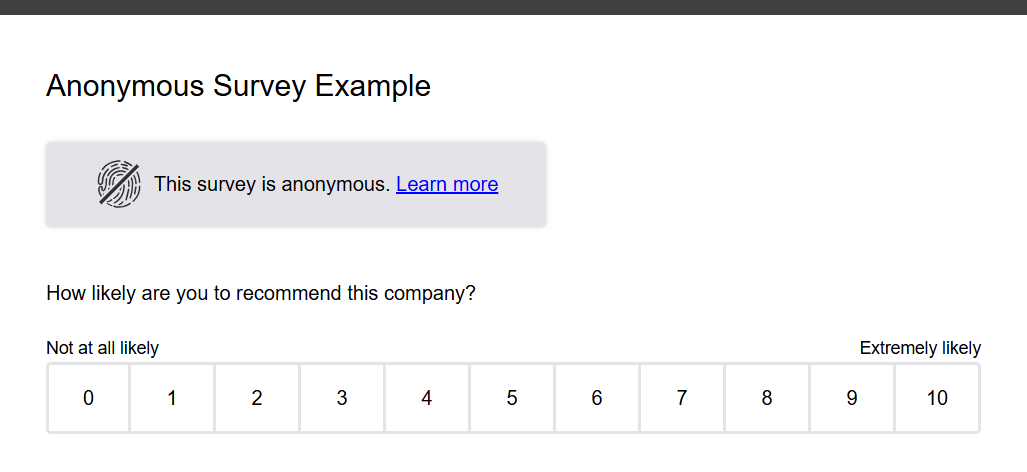
To build participant trust, a clickable privacy label appears at the top of the form, confirming to respondents that responses will remain anonymous and explaining how privacy is protected. This approach encourages more candid feedback by reducing concerns about being tracked and clearly explaining the methodology used. Below is an example of an anonymous survey showing this label:
The following information is not available to the survey author and is automatically hidden when conducting an anonymous survey:
- Names or email addresses
- IP addresses
- Device or browser data
- Query strings or tracking parameters
- Submission timestamps tied to individuals
- Passwords or access codes
- Respondent identities
Survey results:
- Do not include identifying details
- Are reported without individual attribution
- Cannot be used to trace responses back to respondents
When to Use Anonymous Surveys
Anonymous surveys are used across industries to collect feedback in situations where privacy is a concern. They’re commonly used for sensitive employee feedback, internal votes, and early-stage product testing where individual identities should not be tracked.
Since October 2024, SurveyKing’s anonymous survey collector has been used 244 times to collect more than 13,000 responses, averaging over 50 responses per survey. This usage suggests that anonymous surveys are being used beyond traditional HR feedback, including in pricing studies, product research, and academic research.
| Anonymous Survey Category | Usage Count | Usage Percentage |
|---|---|---|
| Employee | 108 | 44% |
| Market Research | 41 | 17% |
| Student | 29 | 12% |
| General Feedback | 21 | 9% |
| Voting | 6 | 2% |
| Union | 3 | 1% |
| Uncategorized | 32 | 13% |
Employee Feedback
Still one of the most common use cases, anonymous employee surveys help teams capture honest feedback, surface new ideas, and reduce turnover. SurveyKing supports quarterly, annual, and pulse employee surveys with built-in benchmarking, giving HR leaders real data they can act on without compromising employee trust.
A less commonly discussed but important use case for anonymous employee surveys is part of financial due diligence services. These surveys help organizations identify turnover concerns, key-person dependencies, and employee sentiment around leadership. Anonymous feedback may reveal operational risks that are difficult to identify solely through financial reporting.
Market Research
Although anonymity isn’t traditionally associated with market research, over 20% of anonymous surveys on SurveyKing are now used for pricing tests, product validation, and early-stage research. When respondents don’t feel tracked, feedback tends to be more candid and less influenced by brand perception or future targeting, making anonymous surveys a fast, unbiased way to capture real-world sentiment.
General Feedback
General feedback surveys are often used when organizations want to cast a wide net: to capture ideas, frustrations, or opportunities they hadn’t considered. Based on our data, these surveys frequently include questions like:
- What’s one thing we could do better?
- What did you feel was missing from your experience?
- How effective was our communication during the event?
Voting & Elections
Anonymous surveys are frequently used to conduct internal elections, leadership polls, and member-based decision votes. Whether it’s a student government, nonprofit board, or small organization, anonymity helps ensure fairness, especially when the stakes are high.
Labor Union Surveys
Unions frequently rely on anonymous surveys during contract negotiations. Every voice counts, and anonymity improves response rates and honesty.
Academic Research & Student Polling
From K–12 to higher ed, anonymous surveys help researchers gather insights on courses, faculty, and student life. School administrators can also use them for peer reviews or extracurricular planning, where privacy encourages participation. These surveys often reach response rates over 50, helping universities make informed decisions.
Sensitive or At-Risk Group Feedback
When interviewing vulnerable populations such as immigrants, patients, and community members, anonymity isn't only helpful but also essential. Many respondents won't open up unless their identity is protected. That's why SurveyKing displays a verified "Anonymous" seal to build trust and encourage honest participation.
Anonymous Survey Questions
The questions below are designed for anonymous surveys and focus on opinions and experiences without requesting identifying information. When writing anonymous questions, avoid wording that could indirectly reveal a respondent’s role, class size, or personal circumstances, especially in small groups.
Employee Feedback
- I believe in the company’s mission (rating)
- Leadership puts the company in a position to succeed (rating)
- My manager actively supports me (rating)
- I have the tools needed to do my job (rating)
- My feedback is valued (rating)
- What’s one thing leadership could do better? (open-ended)
- What concerns do you feel uncomfortable raising publicly? (open-ended)
Workplace Training
- The training content was relevant to my role (multiple choice)
- The training prepared me to apply the material in real work scenarios (rating)
- The instructor clearly explained how concepts apply on the job (rating)
- I feel more confident performing my work after this training (rating)
- What could be improved to make this training more practical? (open-ended)
Anonymous feedback can be collected using a training evaluation form linked to a QR code that is placed on slides or printed materials. This allows participants to respond immediately after the session while preserving anonymity and supporting consistent evaluation across trainings.
Education Feedback
- How clearly did the instructor explain the course material? (rating)
- The course structure supported my learning (rating)
- The instructor encouraged participation and questions (rating)
- The course was a productive use of my time (rating)
- How helpful were the homework assignments in supporting your progress? (multiple choice)
- What could the instructor or course design improve? (open-ended)
Customer Satisfaction
- Overall, how satisfied are you with your experience? (rating)
- How well did we meet your expectations? (rating)
- How easy was it to complete your task or purchase? (rating)
- What frustrated you most about your experience? (open-ended)
- What could we do to improve your experience? (open-ended)
Market Research
- How appealing do you find this product or concept? (rating)
- What are the least and most important features in the product? (MaxDiff)
- What factors most influenced your opinion? (open-ended)
- What would prevent you from using or purchasing this product? (open-ended)
- What alternatives are you currently considering? (open-ended)
How to Create an Anonymous Survey
Creating a truly anonymous survey means more than hiding names. It requires careful planning so that no combination of answers can reveal someone’s identity while still providing actionable data. Here are four steps to design an anonymous survey:
1. Define Objectives
Start with clear objectives. Strong goals prevent adding “nice to have” questions that might compromise anonymity. If you need to include sensitive details, such as department or role, do so only when they are essential to meeting your objectives, and frame them carefully to avoid identifying individuals.
2. Create a Privacy Statement
An introductory privacy statement (often called an anonymous survey statement) is essential because it establishes trust from the start. This message should appear at the beginning of the survey and clearly explain to respondents upfront:
- That the survey is anonymous and how identities are protected.
- Why the data is being collected.
- How results will be reported (always at a group level, never individually).
- That opting out is an option.
If conducting an anonymous employee survey via email, encourage respondents to complete it on a personal device. This can help reduce concerns about employers monitoring web traffic, tracking when survey links are clicked, or cross-referencing click times with early survey responses. Including a QR code in the invitation can also make it quick and simple to access the survey from a personal device.
3. Draft the Questions
Keep questions clear and purposeful. Since you won’t be able to follow up with respondents, each question needs to stand on its own. Stick to formats that encourage honest feedback while aligning with your objectives.
- Net Promoter Score (NPS) - A quick, anonymous benchmark of sentiment. Results can be tracked internally over time or compared against other companies, all without identifying individuals.
- Open Text (with caution): Allow space for comments, but remind participants not to include sensitive details. Responses can be automatically tagged to identify themes and problem areas. A common approach is to place an open-text question right after NPS to capture context behind the score.
- Multiple Choice – Ideal for structured feedback where responses fit into predefined categories. You can allow respondents to select one answer (single-select) or multiple answers (multi-select), depending on the question. Adding an “Other” option with a comment box helps capture feedback that doesn’t fit your listed choices. Multiple choice works best when you have clear predefined answer choices.
- Rating Scales - Useful for capturing priorities or levels of satisfaction without being overly personal. Multi-row rating scales are often used to measure characteristics of workplaces, training, or services in a single survey.
- MaxDiff - Reveals true priorities while protecting anonymity. For example, in an employee survey, it can highlight which benefits (health plan, remote work, flexible hours, training budget) matter most, or which workplace improvements (equipment, communication, facilities) should be prioritized.
4. Review Anonymity Risks
- When asking for sensitive data like department or location, group small populations (e.g., teams of 10 people or fewer) into broader categories and always include a “Prefer not to answer” option.
- Ensure survey logic and wording avoid singling anyone out.
- Double-check that open-text questions don’t invite identifying details, such as project numbers, client names, or specific interactions.
Collecting Anonymous Survey Responses
Anonymous survey responses can be collected in different ways, depending on your goals. A shareable survey URL is a simple option, while email distribution provides more control. On SurveyKing, every anonymous questionnaire displays a visible seal at the top of the form, reassuring participants that their identities are protected. This transparency builds trust and encourages honest feedback.
URL Distribution
Surveys can be shared using a secure, anonymous URL sent via email, posted on social media, or converted into a QR code for quick access. Each survey generates a unique link designed to preserve anonymity, with optional settings to allow multiple responses per device and to customize the URL ending.
Email Distribution
You can distribute anonymous surveys by uploading a list of recipients and sending invitations directly from the platform. While high-level delivery and completion status are tracked, survey authors cannot see which individuals have responded. Reminder emails can be sent without revealing identities, and the email collector can be reset for follow-up waves without affecting existing responses.
Anonymous vs. Confidential Surveys
When running surveys, the difference between anonymous and confidential isn’t just semantics; it defines the level of privacy respondents have. Mixing the two terms can create confusion and erode trust, so it’s essential to be clear.
Anonymous surveys: Responses are never tied to personally identifiable information (PII). Survey authors cannot access names, IP addresses, device details, or submission times. Even demographic questions are optional, so results cannot be traced back to individuals. This design encourages more candid feedback, especially on sensitive topics.
Confidential surveys: Responses are tied to individual records such as employee IDs or emails, but only authorized administrators or researchers can view this information. Results are typically shared in aggregate with managers or leadership. While confidential surveys allow deeper analysis by team, tenure, or role, some respondents may be less candid if they worry about traceability.
The right approach depends on your goals. Anonymous surveys prioritize honesty and reduce bias, making them ideal for sensitive topics. Confidential surveys, on the other hand, allow segmentation and targeted follow-up, which is valuable when leadership needs to understand feedback by department, role, or demographic. In both cases, transparency about what information is accessible builds trust.
In our experience, fully anonymous surveys run through a neutral third party help build trust and increase participation, especially among sensitive groups. When respondents know their identities are protected, feedback is more candid and actionable.
Frequently Asked Questions
Below are answers to some of the most common questions about anonymous surveys, including how SurveyKing handles respondent privacy and anonymous response collection.
Why do people use SurveyKing for anonymous surveys?
SurveyKing includes a dedicated anonymous survey feature with a separate response collector and privacy notice shown at the top of the survey. This helps organizations collect honest feedback while making it clear to respondents that responses are anonymous. Anonymous surveys are commonly used for employee feedback, academic research, and workplace reporting.
Does SurveyKing track respondents?
No. SurveyKing does not use trackers, ads, or analytics on anonymous surveys and does not share metadata like IP addresses, browser details, geolocation, or timestamps with the survey creator. A browser cookie may be used only to help prevent duplicate submissions.
Can the survey author see my responses?
The survey author can view survey responses, but they cannot see who submitted them or access identifying information such as IP addresses or timestamps. Responses remain anonymous unless the survey directly asks for personal information within the survey questions, which should be avoided when using an anonymous survey.